Short answer: An interior design layout plan is a professional planning framework that defines how space is organized, measured, and used before design execution. It establishes furniture placement, circulation paths, room proportions, and functional zones with accurate dimensions so that interiors feel comfortable, efficient, culturally appropriate, and buildable for residential and commercial projects.
What Is An Interior Design Layout Plan
An interior design layout plan is a scaled drawing and planning system that shows how furniture, circulation, activity zones, and clearances are arranged within a space. It is not decoration. It is a functional decision making tool used before selecting finishes, lighting fixtures, or furniture styles.
In professional practice, the layout plan answers fundamental questions. Where do people walk. Where do they sit, work, rest, or gather. How much space is required for comfort and safety. Without resolving these questions, even the most expensive interiors fail in daily use.
In residential projects across Qatar and the wider MENA region, layout plans often determine whether a villa feels welcoming or awkward. We frequently encounter large homes where rooms feel uncomfortable because furniture placement and circulation were never properly planned.
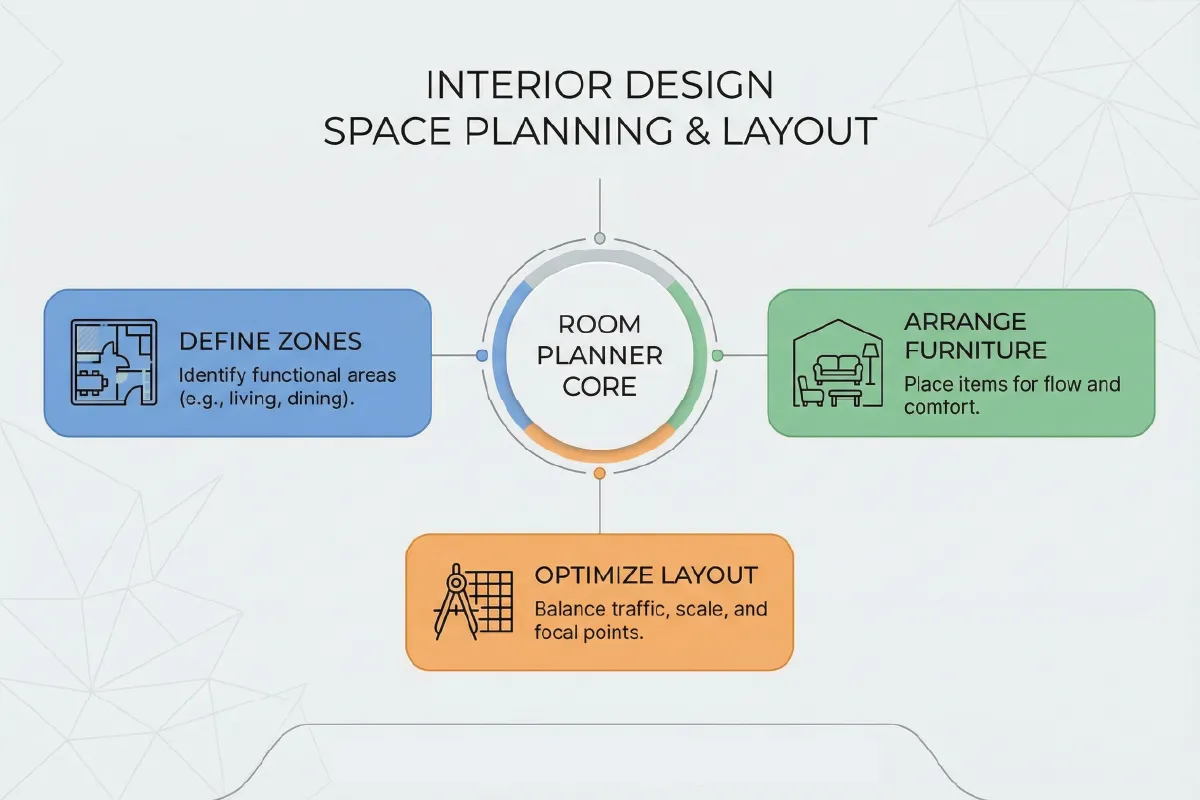
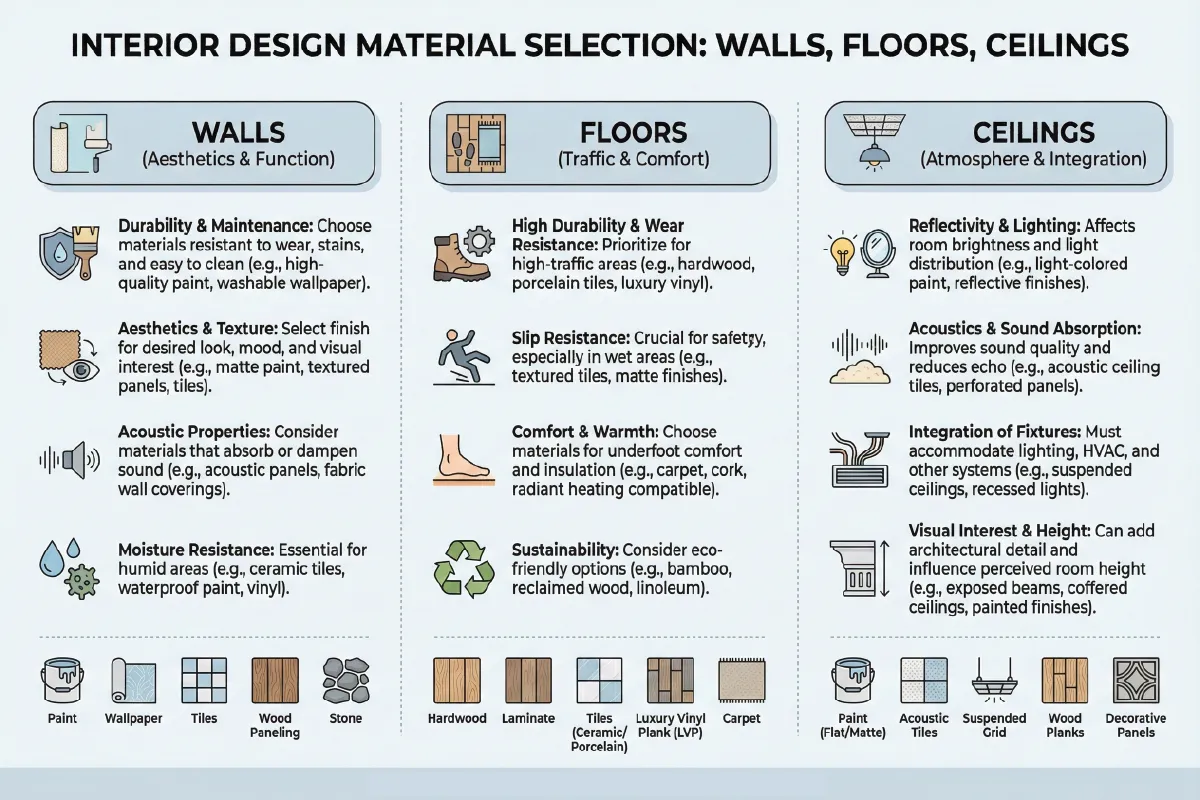
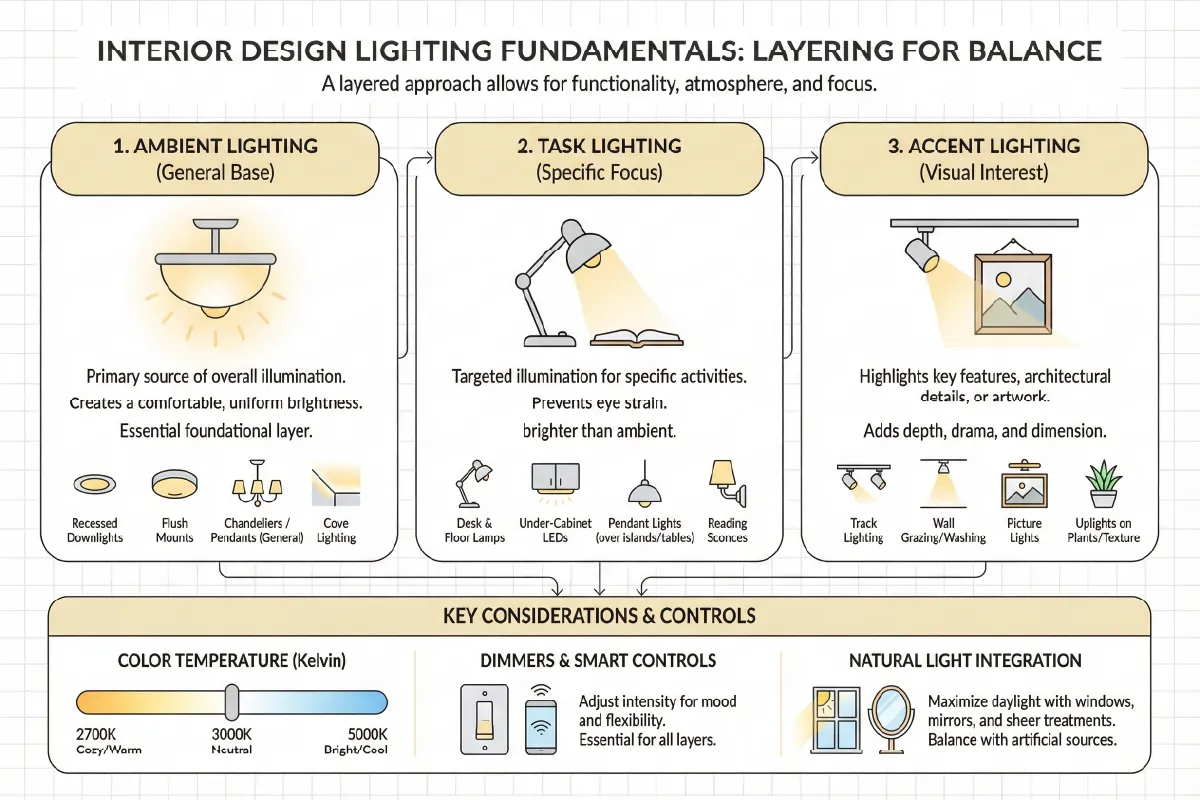
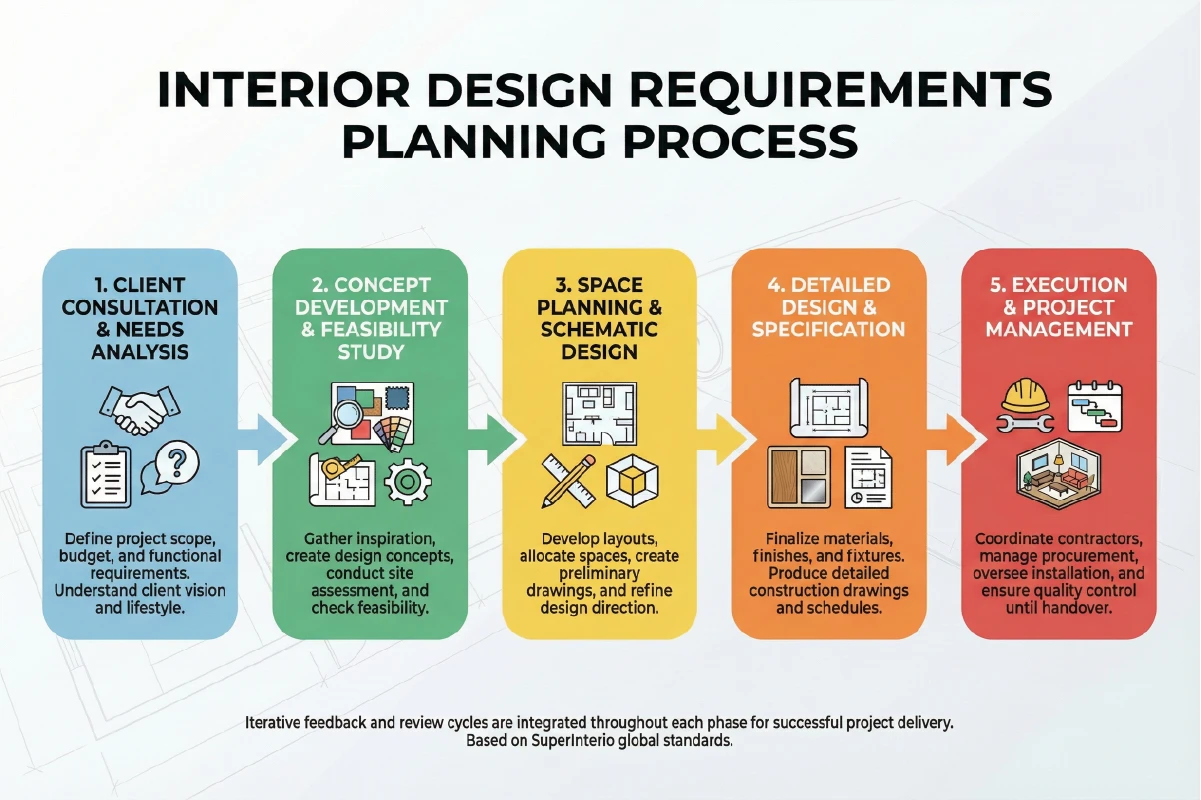
A correct layout plan aligns closely with space planning requirements, supports lighting requirements, respects material selection requirements, and follows the interior design requirement planning process.
Imagine a living room where seating blocks natural circulation or a dining table placed too close to walls. These are not style problems. They are layout planning failures.
Why An Interior Design Layout Plan Is Critical
An interior design layout plan is critical because it directly affects comfort, usability, safety, and long term satisfaction. Layout decisions influence how people experience a space every day, not just how it looks in photographs.
From experience, most client complaints after handover are linked to layout issues rather than finishes. Spaces feel cramped, circulation feels awkward, or furniture does not function as expected. These problems are expensive to fix once construction is complete.
- Prevents circulation conflicts and congestion
- Ensures correct furniture proportions
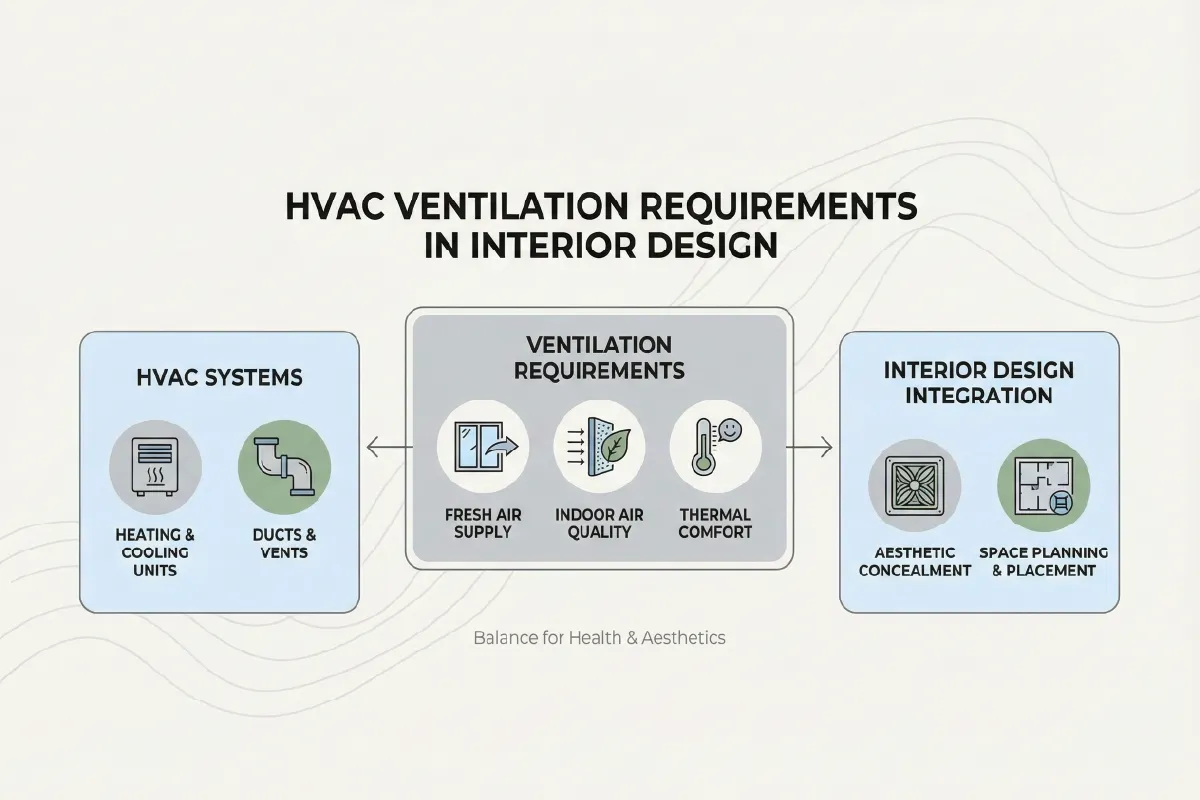
- Supports lighting and HVAC performance
- Reduces redesign and execution changes
In commercial interiors, layout planning becomes even more critical. Office productivity, retail flow, and hospitality experience all depend on efficient layout decisions that respect clearances, accessibility, and operational needs.
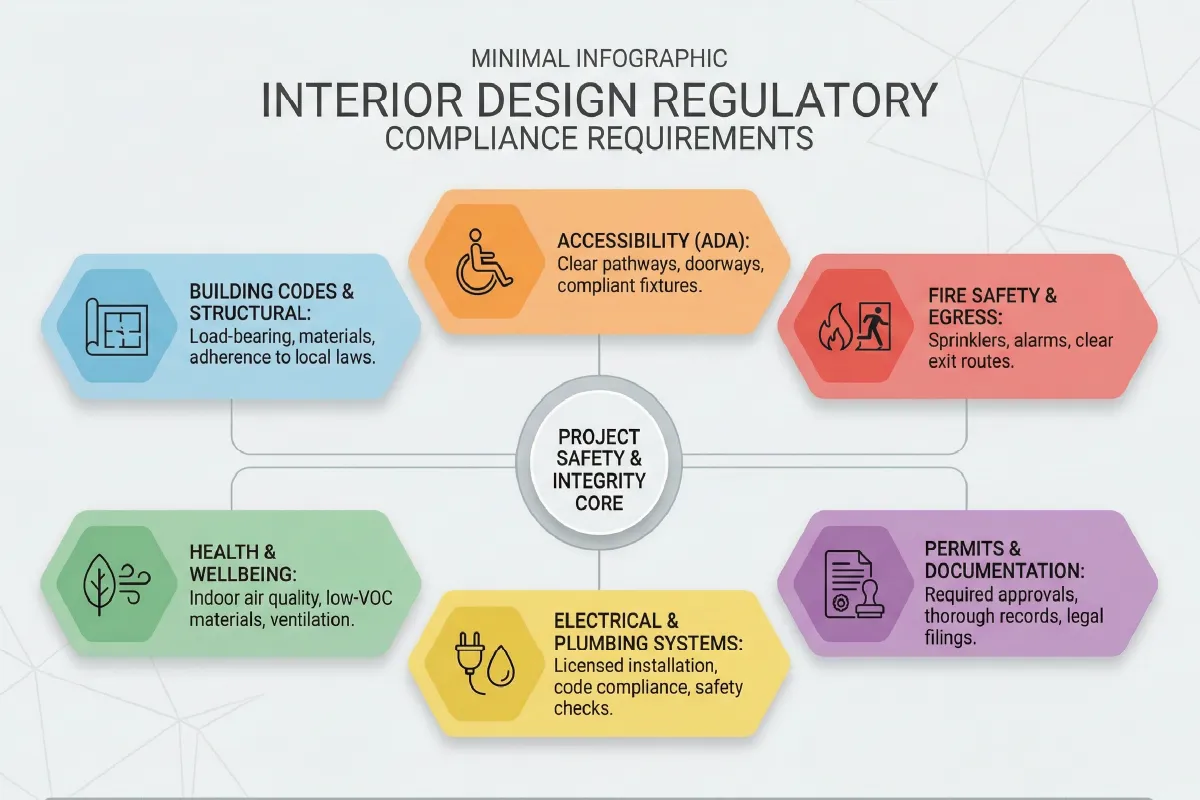
In fact, many regulatory issues identified during authority review can be traced back to poor early layout planning, particularly in relation to circulation and accessibility.
Core Principles Of Interior Design Layout Planning
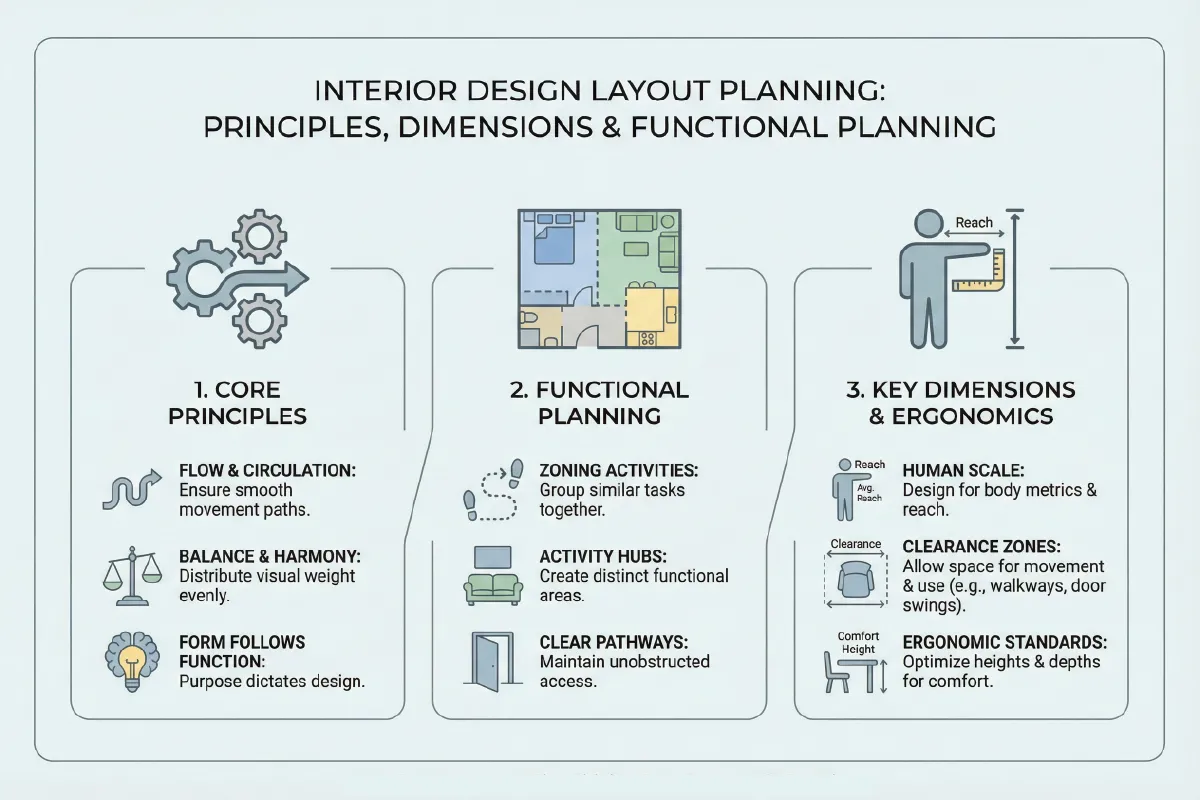
Interior design layout planning follows clear professional principles that balance human behavior, spatial efficiency, and visual comfort. These principles apply across residential and commercial projects, although their interpretation may vary culturally.
In Middle Eastern interiors, for example, hospitality and privacy strongly influence layout decisions. Guest seating areas are often separated from family zones, and circulation must respect cultural norms.
- Clear circulation paths without obstruction
- Logical zoning based on activity
- Balanced proportions between furniture and room size
- Visual hierarchy and focal points
- Comfortable interaction distances
One practical rule we apply consistently is that circulation should never pass through the center of a primary activity zone. When movement cuts through seating or sleeping areas, spaces feel unsettled and uncomfortable.
Moreover, layout principles must always be tested against real dimensions, not assumptions. A sofa that looks appropriate in a catalog may overwhelm a room once circulation and clearances are considered.
Functional Planning And Human Behavior
Functional planning focuses on how people actually use spaces, not how designers imagine they should be used. This human centered approach is essential for successful interior layouts.
Before finalizing a layout, experienced designers observe daily routines. How many people use the space simultaneously. How often furniture is moved. Where personal belongings are placed. These observations inform practical layout decisions.
In a recent Qatari villa project, adjusting the seating layout to accommodate family gatherings during weekends transformed the living room from formal and underused to lively and comfortable, without changing finishes or furniture quality.
Functional planning ensures that layout plans support real lifestyles, business operations, and cultural habits rather than forcing occupants to adapt to poorly planned spaces.
Dimensions Clearances And Measurement Standards
Short answer: Interior design layout plans must be based on accurate dimensions and minimum clearances to ensure comfort, safety, and usability. Guesswork in measurements is the most common cause of failed layouts in both residential and commercial interiors.
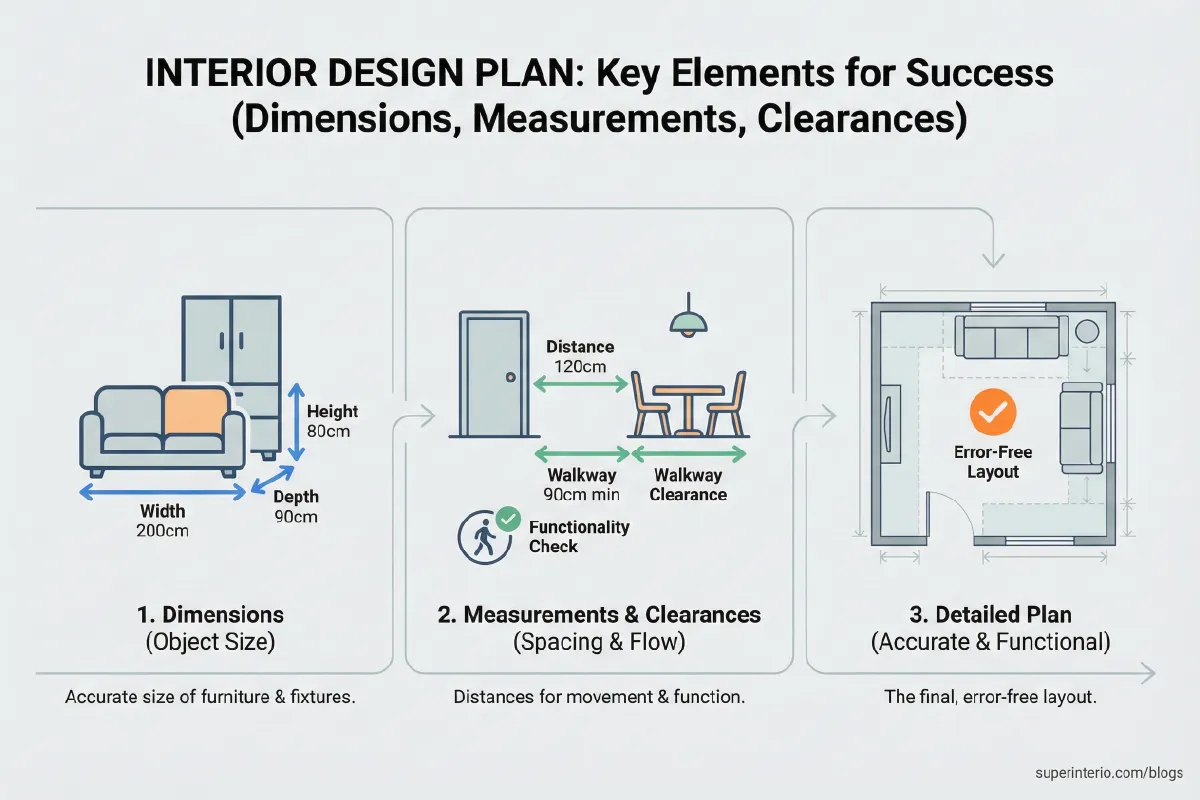
In professional practice, every layout plan is developed using scaled drawings. Furniture sizes, circulation widths, door swings, and functional zones are measured precisely within an interior design plan with dimensions so that spaces work in real life, not just on paper.
From experience in Gulf residential projects, many layout problems arise because furniture was selected first and dimensions were adjusted later. This approach almost always leads to congestion and poor circulation.
| Area | Recommended Minimum Clearance | Functional Purpose |
|---|---|---|
| Main Circulation Paths | 900 To 1200 Millimeters | Comfortable Movement And Accessibility |
| Around Dining Tables | 900 Millimeters | Chair Movement And Walking Space |
| Around Beds | 750 To 900 Millimeters | Ease Of Access And Daily Use |
| Kitchen Work Zones | 1000 To 1200 Millimeters | Safe And Efficient Workflow |
| Office Workstations | 900 Millimeters Minimum | Ergonomic Movement |
These dimensions may vary depending on project type, occupancy, and local regulations, but they form a reliable baseline for functional planning.
Accurate dimensioning also supports regulatory and compliance requirements, particularly in relation to accessibility and fire egress.
Interior Design Plan With Dimensions
Short answer: An interior design plan with dimensions communicates exact sizes, distances, and relationships between elements so that layouts can be executed accurately on site.
Dimensioned plans are essential for contractors, suppliers, and consultants. Without them, execution relies on assumptions, leading to errors and delays.
In residential interiors, dimensioned plans ensure furniture fits correctly, doors open without obstruction, and circulation remains comfortable. In commercial interiors, they are critical for coordination with mechanical, electrical, and fire systems.
- Overall room dimensions
- Furniture sizes and positions
- Clearances and circulation widths
- Door and window openings
- Fixed elements such as counters and partitions
In practice, we often prepare multiple dimensioned layouts during design development. Each iteration refines usability before final approval.
Residential Versus Commercial Layout Planning
Short answer: Residential and commercial layout planning differ in scale, usage intensity, and regulatory requirements, even though they share core planning principles.
Residential layouts prioritize comfort, privacy, and flexibility. Commercial layouts prioritize efficiency, capacity, safety, and operational flow.
| Aspect | Residential Interiors | Commercial Interiors |
|---|---|---|
| Primary Focus | Comfort And Lifestyle | Efficiency And Operations |
| Circulation | Flexible And Informal | Structured And Regulated |
| Furniture Density | Moderate | Higher And More Standardized |
| Compliance | Basic Residential Standards | Strict Accessibility And Safety |
Applying residential layout logic to commercial interiors often results in inefficiencies and compliance issues. Similarly, applying rigid commercial standards to homes can reduce comfort.
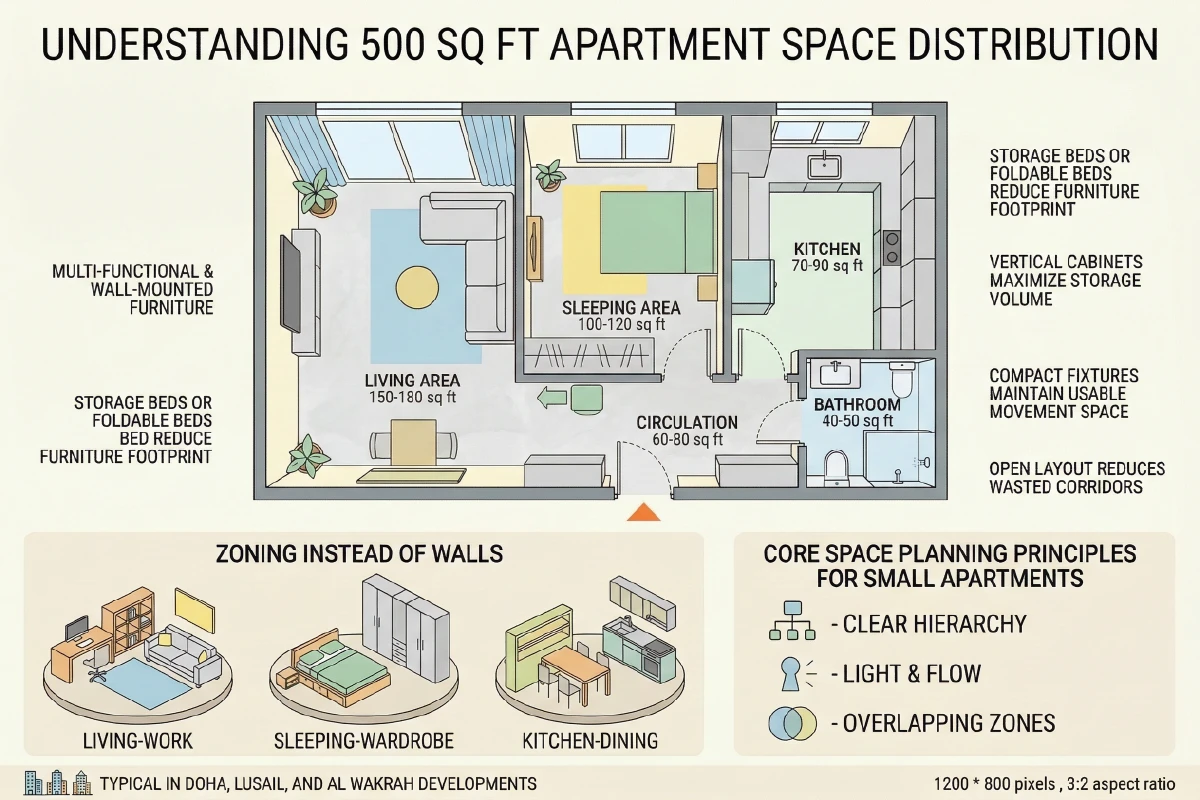
Layout Planning And Functional Zoning
Short answer: Functional zoning divides a space into clear activity areas so that layouts remain organized and intuitive.
Zoning is especially important in open plan interiors, which are common in modern homes and offices across Asia and MENA.
- Public zones for guests and interaction
- Private zones for rest and focused work
- Service zones for utilities and storage
Clear zoning improves circulation, reduces visual clutter, and enhances privacy without the need for excessive partitions.
Effective zoning works in harmony with HVAC and ventilation requirements and lighting distribution.
Real World Layout Planning Examples From Gulf Interiors
Short answer: Real world layout planning succeeds when design decisions are based on lifestyle patterns, cultural expectations, and measurable space usage rather than visual assumptions.
Let us consider a Qatari family villa where the living room was originally designed as a large formal space. Despite its size, the room felt unused because seating was pushed to the walls, circulation cut through the center, and television viewing angles were uncomfortable.
By reworking the layout plan, the seating was reorganized into a conversational arrangement, circulation was redirected around the perimeter, and furniture spacing was adjusted using accurate dimensions. No finishes were changed. The transformation was achieved purely through layout planning.
In a commercial example, a small professional office in West Bay suffered from congestion despite sufficient area. The issue was traced to incorrect workstation spacing and poorly planned circulation paths. Revising the layout plan improved movement flow and increased usable workspace without expanding the office footprint.
Common Interior Design Layout Planning Mistakes
Short answer: Most layout planning mistakes occur when furniture selection, aesthetics, or assumptions override functional measurement and user behavior.
- Placing furniture before confirming circulation clearances
- Ignoring door swings and access zones
- Overfurnishing rooms beyond functional needs
- Designing layouts without considering lighting and ventilation
- Assuming larger spaces automatically function better
In fact, many layout related issues reported after handover can be traced back to the absence of a properly dimensioned layout plan during early design stages.
Layout Planning And Long Term Usability
Short answer: A well planned layout adapts to changing needs over time without requiring structural changes or major renovations.
Families grow, work patterns change, and businesses evolve. Layout plans that allow flexibility in furniture placement and circulation remain functional longer and reduce future costs.
This long term perspective is especially important in residential investments and commercial lease spaces where adaptability directly affects value.
How To Create An Interior Design Layout Plan
Short answer: Creating an interior design layout plan follows a structured process that translates space requirements into functional, measurable, and buildable arrangements.
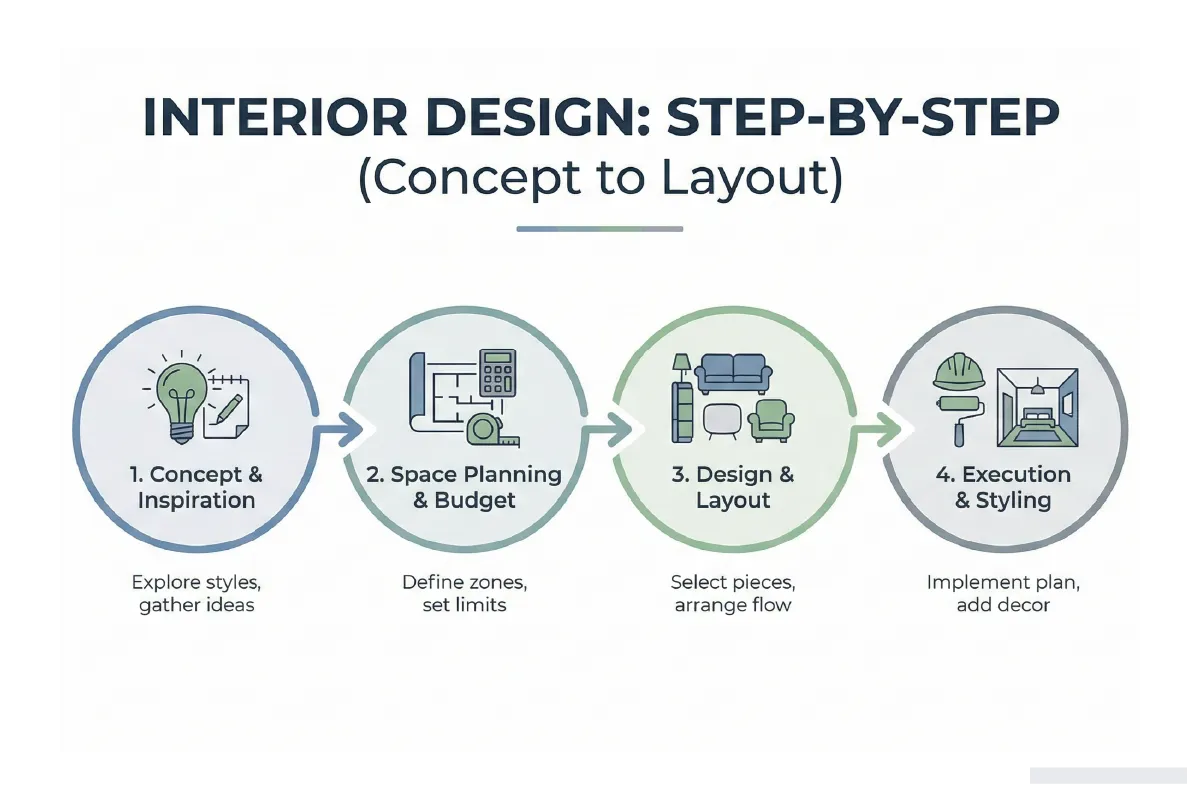
- Analyze The Space And User Requirements: Begin by understanding who will use the space, how often it will be used, and for what activities. Review room dimensions, access points, windows, and fixed elements before any layout decisions are made.
- Define Functional Zones: Divide the space into clear activity zones such as seating, dining, work, rest, or service areas. Zoning should reflect lifestyle patterns, cultural expectations, and operational needs.
- Plan Circulation Paths: Establish clear circulation routes that allow comfortable movement between zones without cutting through primary activity areas. Ensure circulation widths meet comfort and accessibility standards.
- Place Furniture With Accurate Dimensions: Position furniture using real product dimensions rather than assumed sizes. Maintain required clearances around furniture to support usability, access, and door operation.
- Validate Dimensions And Clearances: Check all critical measurements including circulation widths, furniture spacing, and functional clearances. Adjust the layout to eliminate congestion or conflicts.
- Review Layout Against Lighting And HVAC Planning: Confirm that furniture placement and zoning align with lighting distribution and ventilation paths so that comfort and performance are maintained.
- Finalize And Document The Layout Plan: Prepare a dimensioned layout plan that clearly communicates furniture placement, circulation, and zones for coordination with contractors, suppliers, and consultants.
Frequently Asked Questions
What Is An Interior Design Layout Plan
An interior design layout plan is a scaled planning drawing that defines furniture placement, circulation paths, functional zones, and clearances within a space to ensure comfort, usability, and buildable execution.
Why Is An Interior Design Layout Plan Important
An interior design layout plan is important because it prevents circulation issues, ensures correct furniture proportions, supports lighting and HVAC coordination, and reduces costly redesign during construction.
What Is The Difference Between A Layout Plan And A Floor Plan
A layout plan focuses on furniture arrangement, circulation, and functional zoning, while a floor plan shows walls, openings, and fixed structural elements of a space.
Why Are Dimensions Important In Interior Design Layout Planning
Dimensions are important because they ensure adequate clearances, comfortable circulation, accurate furniture placement, and compliance with safety and accessibility requirements.
Do Interior Designers Prepare Layout Plans
Yes, interior designers routinely prepare layout plans to define how spaces function, how furniture is arranged, and how movement flows before finalizing finishes or construction.
Can A Good Layout Plan Improve Small Spaces
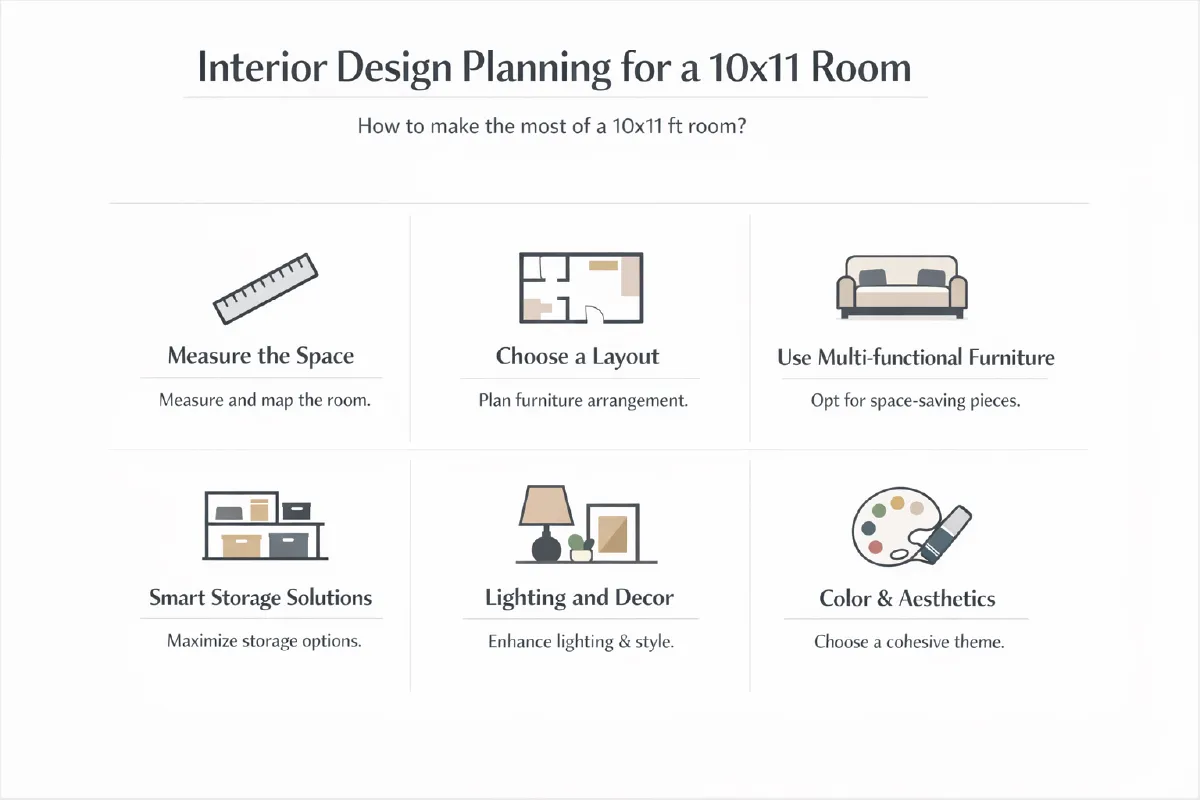
Yes, a well planned layout can significantly improve small spaces by reducing wasted circulation, improving furniture placement, and making rooms feel more open and functional.
When Should Interior Design Layout Planning Be Done
Interior design layout planning should be completed after space planning and before finalizing lighting, materials, furniture selection, and construction drawings.
Key Takeaways
- Layout Planning Comes First: Successful interiors begin with a clear, dimensioned layout plan before decoration or finishes.
- Dimensions Matter: Accurate measurements and clearances prevent usability and circulation issues.
- Function Drives Design: Layouts must respond to real human behavior and cultural context.
- Residential And Commercial Needs Differ: Applying the wrong planning logic leads to inefficiency and discomfort.
- Good Layouts Age Well: Flexible, well planned layouts remain functional as needs change.