Short answer: an interior design estimate is built by breaking a project into measurable components such as space size, scope of work, material quality, labor intensity, authority compliance, and execution complexity, then assigning realistic Qatar-specific costs to each component to arrive at a reliable and controllable budget.
What Is An Interior Design Estimate
An interior design estimate is a professional financial forecast that outlines the expected cost of designing and executing an interior space based on defined assumptions. Unlike a rough budget guess, an estimate is structured, itemized, and grounded in real market conditions.
In practice, when we prepare an estimate for a Doha apartment or a Lusail office, we are not predicting a single number. We are mapping how money flows through design, approvals, construction, and final styling.
Many people confuse an estimate with a quotation. A quotation is a fixed price tied to a finalized scope. An estimate, on the other hand, is an informed projection used during planning stages. It helps you decide what is possible, what needs adjustment, and where compromises may be required.
In fact, a well-prepared estimate is one of the strongest decision-making tools you can have before committing to a contractor or supplier.
Why Interior Design Estimation Components Matter
Let us imagine a familiar scenario. A homeowner in Qatar plans a villa renovation and receives a single lump sum figure. No breakdown. No explanation. At first, it feels simple. Later, every change becomes a cost dispute.
This happens because the estimate was not component-based. When you understand each component of an interior design estimate, you gain control. You know what drives cost and what does not.
From professional experience, projects that fail financially usually fail at the estimation stage. Either key components were ignored or assumptions were unrealistic.
Component-based estimation matters because it:
- Creates transparency between client and designer
- Allows informed material and design decisions
- Prevents hidden cost surprises during execution
- Helps compare proposals objectively
Moreover, in the Qatar market where expectations for finish quality are high, clarity at the estimation stage protects both the client and the design team.
Qatar Specific Factors That Influence Interior Design Estimates
Interior design estimation in Qatar is shaped by conditions that are very different from many other regions. Understanding these factors is essential if you want realistic numbers.
Based on real residential and commercial projects across Doha, West Bay, and The Pearl, these are the most influential local factors.
- Heavy reliance on imported materials
- High expectations for craftsmanship and finishes
- Authority approval requirements for fit out works
- Climate-driven material performance needs
- Labor cost variations based on specialization
For example, a simple ceiling design in another market may become a complex cost item in Qatar due to fire rating requirements and coordination with mechanical systems.
Ignoring these realities leads to underestimation. Proper estimates reflect the true environment in which the project will be built.
Core Components Of An Accurate Interior Design Estimate
A reliable interior design estimate is never based on a single line item. It is the sum of multiple interdependent components that together define the final cost.
In professional practice, we break estimates into clear categories so that each element can be evaluated independently.
| Component | Description | Impact On Total Cost |
|---|---|---|
| Space Area And Layout | Total usable square meters and planning efficiency | High |
| Scope Of Work | Extent of construction and modification required | High |
| Material And Finish Level | Quality and source of finishes and fittings | Very High |
| Labor And Craftsmanship | Skill level and execution complexity | Medium To High |
| Authority And Compliance | Approvals, inspections, and regulations | Medium |
Each of these components must be quantified and priced realistically. Skipping even one creates gaps that eventually show up as cost overruns.
Key Takeaways
- Estimation Is A Planning Tool: It guides decisions before execution begins.
- Component-Based Estimation Works: Breaking costs into parts creates clarity.
- Qatar Has Unique Cost Drivers: Local conditions must be reflected in estimates.
- Accuracy Starts Early: Good estimates prevent disputes and delays.
Space Area And Layout As The First Estimation Component
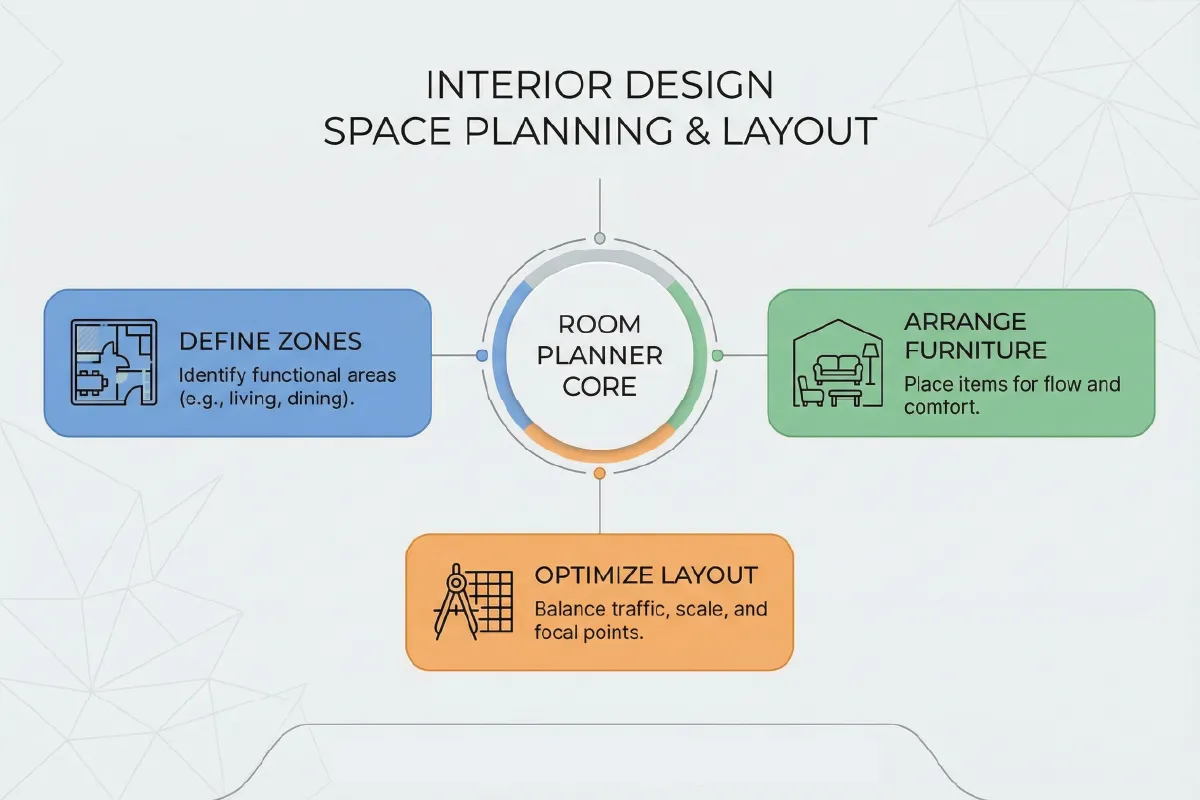
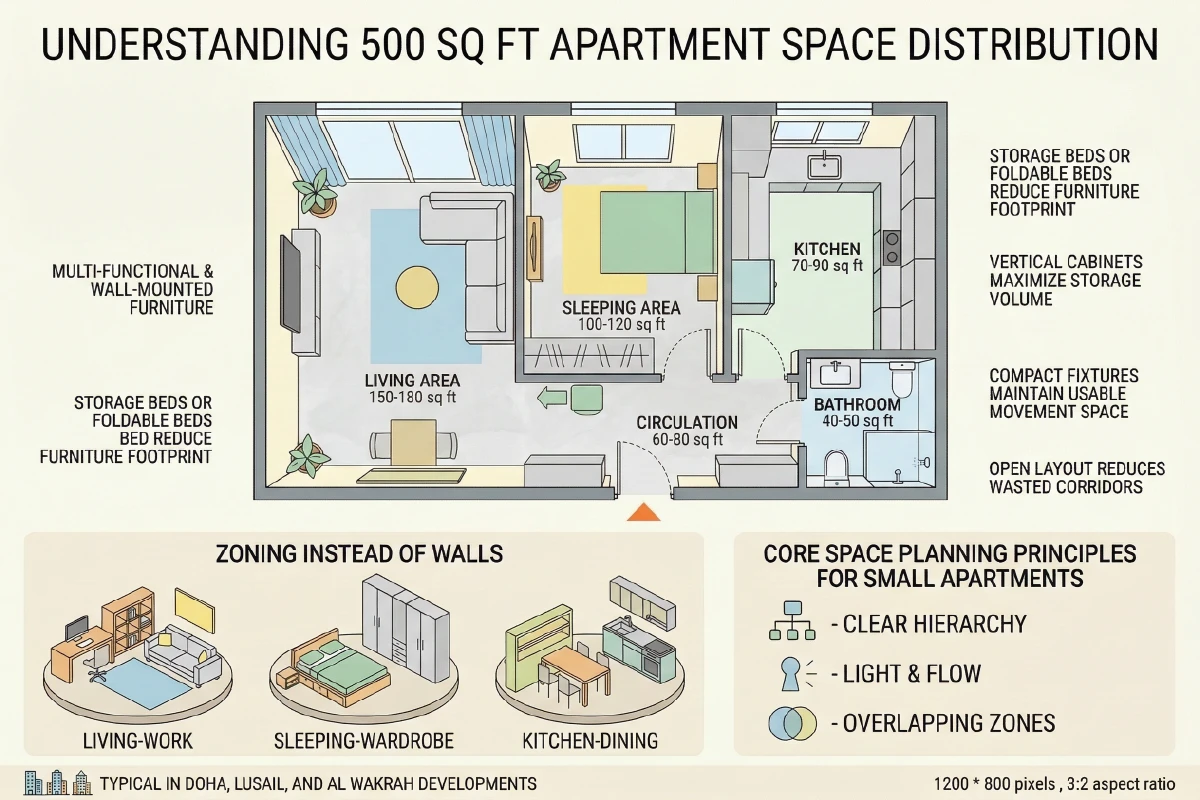
Every accurate interior design estimate begins with one fundamental question: how much space are we actually designing. In Qatar, this sounds simple but often becomes complex due to varying apartment layouts, villa extensions, and mixed use areas.
Area alone does not define cost. Layout efficiency plays an equally important role. A compact 150 square meter apartment with multiple corners, niches, and structural columns may cost more to design than a simple open plan space of the same size.
From experience, projects with poor layout efficiency typically consume higher budgets because of increased partitioning, custom joinery, and circulation adjustments.
| Layout Type | Design Complexity | Cost Impact |
|---|---|---|
| Open Plan | Low | Lower Cost Per Sqm |
| Semi Partitioned | Medium | Moderate Cost Increase |
| Highly Segmented | High | Higher Cost Per Sqm |
When estimating costs, always evaluate how efficiently the space works, not just how large it is.
Scope Of Work Definition And Its Cost Impact
Scope of work is the backbone of every interior design estimate. It defines what will be changed, upgraded, retained, or removed.
In Qatar, scope clarity is especially important because many properties are delivered with base finishes that may or may not align with your design vision.
Let us consider two scenarios. In the first, a client retains existing flooring and ceilings and focuses only on furniture and lighting. In the second, the same space undergoes full demolition and reconstruction. The difference in cost can exceed 60 percent.
| Scope Level | Description | Relative Cost |
|---|---|---|
| Light Upgrade | Furniture, paint, lighting | Low |
| Partial Renovation | Selected flooring, joinery, ceilings | Medium |
| Full Fit Out | Complete demolition and rebuild | High |
A professional estimate always documents scope in writing. This prevents misunderstanding and protects the budget during execution.
Material And Finish Selection As A Major Estimation Driver
Material selection is often the single largest driver of Interior Design Cost variation. Two projects with identical layouts can have dramatically different estimates based solely on finish choices.
In Qatar, clients often prefer materials that communicate longevity, status, and comfort. This naturally influences estimation.
From villas in Al Dafna to apartments in The Pearl, the most common cost escalations occur when materials are upgraded mid project.
| Finish Category | Typical Materials | Cost Influence |
|---|---|---|
| Standard | Ceramic tiles, laminate, basic fixtures | Baseline |
| Mid Range | Porcelain tiles, veneer, branded fittings | Moderate Increase |
| Premium | Natural stone, custom finishes, designer fixtures | High Increase |
An experienced designer helps you allocate premium materials where they matter most and simplify finishes elsewhere.
Labor And Craftsmanship Cost Considerations
Labor cost is not just about wages. It reflects skill level, supervision, sequencing, and quality control.
In Qatar, specialized craftsmanship such as bespoke joinery, feature ceilings, or integrated lighting systems commands higher labor costs due to expertise requirements.
Cutting labor cost often results in compromised execution. From experience, rework due to poor craftsmanship costs more than proper labor allocation from the beginning.
Key Takeaways
- Area Alone Is Not Enough: Layout efficiency directly affects cost.
- Scope Must Be Written: Clear scope prevents disputes.
- Materials Drive Variation: Finish choices shape the estimate.
- Labor Reflects Quality: Skilled execution protects long term value.
Contingency And Risk Buffer In Interior Design Estimates
No matter how detailed an estimate is, real world projects involve variables. That is why contingency is a critical estimation component rather than an optional safety net.
In Qatar, common risks include material lead time changes, late design decisions, site access limitations, and coordination delays. Ignoring these realities leads to financial stress mid project.
Based on professional practice, a realistic contingency allocation ranges between 5 and 10 percent of the total estimated cost depending on project complexity.
| Project Type | Recommended Contingency | Reasoning |
|---|---|---|
| Apartment Interior | 5 Percent | Controlled scope and environment |
| Villa Renovation | 8 Percent | Structural and design variables |
| Commercial Fit Out | 10 Percent | Authority and operational risks |
Contingency does not mean you will overspend. It means you are prepared.
Real World Qatar Case Example Estimation In Practice
Let us consider a real world style scenario based on multiple residential projects executed in Doha.
A family relocates to Qatar and purchases a 220 square meter villa. Their vision is modern, warm, and functional. Initially, they request a single budget figure. Instead, we guide them through component based estimation.
By breaking the estimate into area, scope, materials, labor, approvals, and contingency, they clearly understand where each decision impacts cost. As a result, they choose premium finishes for public spaces and simplify private areas.
The final execution remains within 3 percent of the original estimate. This outcome is only possible when estimation is treated as a design discipline, not a guessing exercise.
Frequently Asked Questions
What Is The Difference Between An Estimate And A Quotation
An estimate is a planning projection based on assumptions, while a quotation is a fixed price based on finalized scope and specifications.
Why Do Interior Design Estimates Change During Projects
Changes usually occur due to scope modifications, material upgrades, or unforeseen site conditions. Clear estimation reduces but does not eliminate changes.
Is It Possible To Get An Accurate Estimate Before Design
Preliminary estimates can be accurate within a controlled range when based on experience and local data, but final accuracy improves with detailed design.
Should Authority Costs Be Included In Early Estimates
Yes. Excluding them leads to misleading budgets and approval delays.
Key Takeaways
- Estimation Is Component Driven: Accurate budgets are built piece by piece.
- Local Knowledge Matters: Qatar specific factors shape real costs.
- Compliance Is Not Optional: Authority requirements must be planned.
- Contingency Protects Projects: Risk buffers ensure financial stability.
References
- Qatar Fit Out Approval And Compliance Guidelines
- Interior Design Cost Benchmarking Based On Market Practice
- Professional Experience In Residential And Commercial Projects In Qatar